





Chicken’s Neck: Geopolitical Tensions and Why It is a Strategic Security Concern for Nepal


२७ पुष २०८२
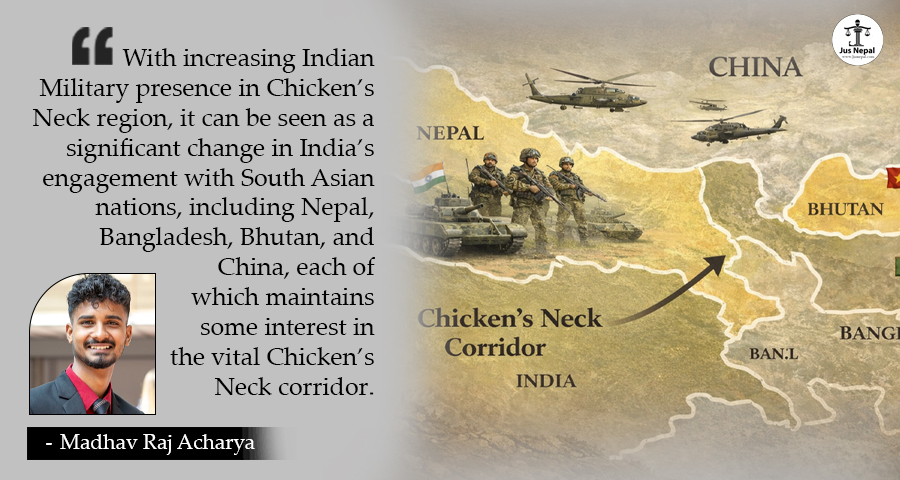
India has recently set up three new military bases near the Bangladesh border to strengthen regional security, one at Lachit Borphukan Military Station in Dhubri, Assam and two forward bases in Kishanganj, Bihar and Chopra, West Bengal.
Understanding the Chicken’s Neck
The Chicken Neck, also known as the Siliguri Corridor, is a narrow stretch of 20-22 kms wide territory, that falls between Nepal and Bangladesh, is the most geopolitical sensitive land passage in South Asia and connects mainland India with its seven northeastern states, also known as the seven sister states. Therefore, these deployments in a very tight geopolitical chokepoint raise key questions about India’s changing security strategy in South Asia and show a significant shift in India-South Asia regional dynamics.
Militarizing the Sensitive Chicken’s Neck Region
The Siliguri Corridor is a narrow stretch of land bordered by Nepal on the west, Bhutan on the north, and Bangladesh on the south. It serves as a significant logistical lifeline for India, providing key road, rail and defense links to the northeastern region, which spans about 262,230 sq. km (around 8% of India’s territory) and is home to more than 40 million people.
The corridor is vital not only for military movement but also for economic activity, handling nearly 95% of exports from northeastern states such as Assam, Meghalaya, Manipur, Nagaland and Arunachal Pradesh. Likewise, the corridor is a crucial route for transport, trade and communication with India’s northeastern states. It also supports trade links with neighboring countries and ASEAN members. Therefore, any disruption whether due to conflict, blockade or geopolitical tension, would seriously affect connectivity of mainland India to the Northeast and pose a serious challenge to India’s national integrity.
India’s Military Steps
To address this long-standing vulnerability, India has taken significant steps by setting up three new military garrisons. The most important among them is the Lachit Borphukan Military Station in Dhubri, Assam, which is India’s first major Army base in the state. Built across 196 bighas (26.2 hectares) and with the capacity to house 1,500 army personnel including a Para Special Forces unit, it operates under the 4 Corps (Gajraj Corps) of Tezpur, Assam. This base will serve as a hub for technical intelligence, surveillance, area control, and counter-infiltration operations, marking a significant boost to India’s defense and operational strength.
To enhance connectivity and operational readiness, two additional forward bases are being built under the Brahmastra Corps, where the Kishanganj base in Bihar will ensure troop deployment and logistical support, while the Chopra base will coordinate intelligence and response operations along the border. The region, already hosting Raffle fighter jets, capable of strikes over 150 km, BrahMos missile units, and S-400 air defense systems, has recently added the above three major military garrisons. Most, importantly there is Trishakti Corps, which includes the Army, Navy and Air Force to secure its borders.
Likewise, the Trishakti Corps of the Indian Army, stationed in the Sukna region of West Bengal, conducted a field exercise named Teesta Prahar last May, which included the deployment of T-90 tanks. Furthermore, on 22 November 22 2025, in Siliguri, with the presence of all Indian security agencies, the Multi-Agency Center decided to tighten security along the borders with Bangladesh and Nepal.
Regional Developments around the Chicken’s Neck
Above the Chicken’s Neck lies the Chumbi Valley, an area where China has rapidly expanded its military infrastructure and is home to the tri-junction of India, China and Bhutan at Doklam, where the 2017 China-India border standoff occurred. Hence, any future tensions in Doklam could potentially affect the Chicken’s Neck region as well.
The south of this region borders Bangladesh, with which India’s diplomatic relations have been tense primarily due to India granting asylum to Sheikh Hasina, a pro-Indian Prime Minister who was recently sentenced to death by Bangladesh’s International Crimes Tribunal (ICT) for the July 2024 incident. Earlier, before taking asylum in India, Hasina reportedly claimed that there were plans to divide parts of Bangladesh and Myanmar to form a new Christian state, similar to East Timor. Additionally, there were allegations regarding the establishment of a U.S. military air base on Saint Martin’s Island in southern Bangladesh.
Interestingly, the U.S. military conducted joint exercises in this region following the formation of the Mohammad Yunus government. In June, China hosted a trilateral foreign office consultation with Pakistani and Bangladeshi counterparts in Kunming, Yunnan Province of China, an event viewed by some observers as an attempt to strengthen regional linkages without India’s participation. Moreover, military exercises with the United States, such as Tiger Lightning 2025 and Operation Pacific Angel 25-3 have been observed as potential moves by major powers to expand their influence in the region through Bangladesh.
These days, India has consistently ignored Bangladesh’s requests for extradition of Hasina, as a result Bangladesh appears to have strengthened its ties with the United States, China and Pakistan. Notably, about 10-12 km from the Chicken’s Neck, Bangladesh is developing a new airbase at Lalmonirhat. Historically, a military airfield was built at Lalmonirhat in 1931 during British rule and played an important role in the Second World War, but it was later abandoned. Bangladesh is now working to make the Lalmonirhat airport fully operational.
Likewise, on November 8, a Pakistan Navy ship visited Chattogram port in Bangladesh, the first visit of its kind since 1971 A.D., followed by meetings between Pakistan’s Navy chief and Bangladesh’s Army chief to discuss defense cooperation. In fact, the Yunus administration has revealed plans to purchase USD 2.2 billion worth of advanced Chinese J-10CE fighters and is collaborating with Beijing to set up a drone manufacturing hub to strengthen its domestic defense industry.
Interestingly, the country’s de facto Prime Minister Muhammad Yunus visited China this April, after which these developments may have accelerated in Bangladesh. China has also made significant inroads in Bangladesh through its Belt and Road Initiative (BRI) projects. Meanwhile, Pakistan has offered to sell its JF-17 Block III Thunder jets, co-produced with Beijing to Dhaka, along with possibilities for other defense related cooperation.
Historical and Geopolitical Significance of the Chicken’s Neck
Previously, the region now known as Bangladesh was East Pakistan, which became an independent state in 1971 A.D with the assistance of the Indian military. Above the Chicken’s Neck, there was a country named Sikkim, which shared a border with Nepal and was annexed by India in 1975, becoming its 22nd state. Indian security analysts frequently mention that India seeks to widen the Chicken’s Neck because the current 20-22 km width limits full military activity, as any extensive use could violate international airspace, a challenge India faced during the 1962 Sino-Indian War. Therefore, any attempt by India to widen the Chicken’s Neck could be very concerning for both Nepal and Bangladesh.
China also recognizes the strategic importance of the Chicken’s Neck. During Mao Zedong’s rule, northeastern Indian militant groups such as the Nagas, Mizos, and Manipuris received guerrilla training on Chinese territory. Even today, several militant groups from Assam and Nagaland rely on China. From Naksalbari, the heart of Siliguri, the Indian Maoist revolution began, which in turn inspired the Jhapa revolution in Nepal that fought against the Panchayat regime. When extremist groups from Assam, Meghalaya and Manipur intensify caste-based activities, Nepalese minorities have historically been displaced. Similarly, Nepali minorities in Bhutan were not granted asylum in the Chicken’s Neck region and eventually came to Nepal.
The Rohingya refugees fleeing Myanmar to Bangladesh have also found residence in Nepal. Moreover, Nepali-speaking people from Darjeeling and Kalimpong have long fought for Gorkhaland but have been constrained due to the strategic significance of the Chicken’s Neck. This region is not only a point of diplomatic tension but also faces numerous other challenges, including illegal migration, religious extremism, separatist movements, armed conflicts and intelligence operations. Although India frames this move as necessary to safeguard the highly sensitive area it raises critical concerns about India’s expanding military posture in the region.
Thus, the Chicken’s Neck region has been crucial in several international strategies and remains a contested area of significant geopolitical importance and with increasing Indian Military presence in this region, it can be seen as a significant change in India’s engagement with South Asian nations, including Nepal, Bangladesh, Bhutan, and China, each of which maintains some interest in the vital Chicken’s Neck corridor.
Strategic Measures for Nepal in the Chicken’s Neck
Instead of confrontation or staying silent, Kathmandu should use diplomatic channels to clarify the purpose, scope and armaments of installations in the Chicken’s Neck area. Nepal could suggest agreements like those between India and China, setting rules for deployments, notifying exercises in advance, and establishing communication to avoid misunderstandings. Nepal should also strengthen border monitoring with drones, radar and intelligence tools to stay informed without escalating tensions. Bringing the issue to regional forums could encourage transparency and cooperation. Nepal should make it clear that it seeks safe, cooperative border management and regional stability not military rivalry it cannot sustain.
(Acharya is studying at Kathmandu School of Law College)